Why Original Art Is Worth More Than You Think — And How to Start Collecting Without Overwhelming Yourself
There is a conversation I have in my studio almost every second Saturday that goes something like this.
Someone comes in, usually someone who has been following my work for a while, someone who clearly loves art and has thought about collecting and they look around for a long time. They ask good questions. They get in real close and look at it carefully. And then, almost apologetically, they say: I am just not sure I am ready to buy original art yet.
I always want to know what that means. Ready how? Ready financially? Ready emotionally? Ready in terms of knowing enough?
And what comes out is almost always some combination of: it feels like a big step, I am not sure I understand what I am paying for, and I do not want to make a mistake.
This article is my attempt to answer all of that honestly — and to tell you why the step is almost certainly smaller than it feels.
What you are actually paying for when you buy an original
When you buy a print — even a beautiful, high-quality print — you are buying a reproduction. It is a copy of something that exists elsewhere, made in an edition that may be limited or may not be, and it does not carry the physical history of having been made by a specific person in a specific moment.
When you buy an original, you are buying that history. You are buying the object itself — the actual surface that came out of my studio, that I touched, that carries the specific decisions I made while making it. The cement under the ink. The white ink lines I drew over the top.
There is one of it. When it is sold, it is gone. That singularity is not just sentimental…it is what gives original work its meaning and, over time, its value.
Every original I sell comes with a certificate of authenticity and my signature on the front and back of the piece. That documentation follows the work permanently. It is the paper trail that connects the piece to me and to the moment it was made — useful now for your own peace of mind, and useful later if the work ever changes hands.
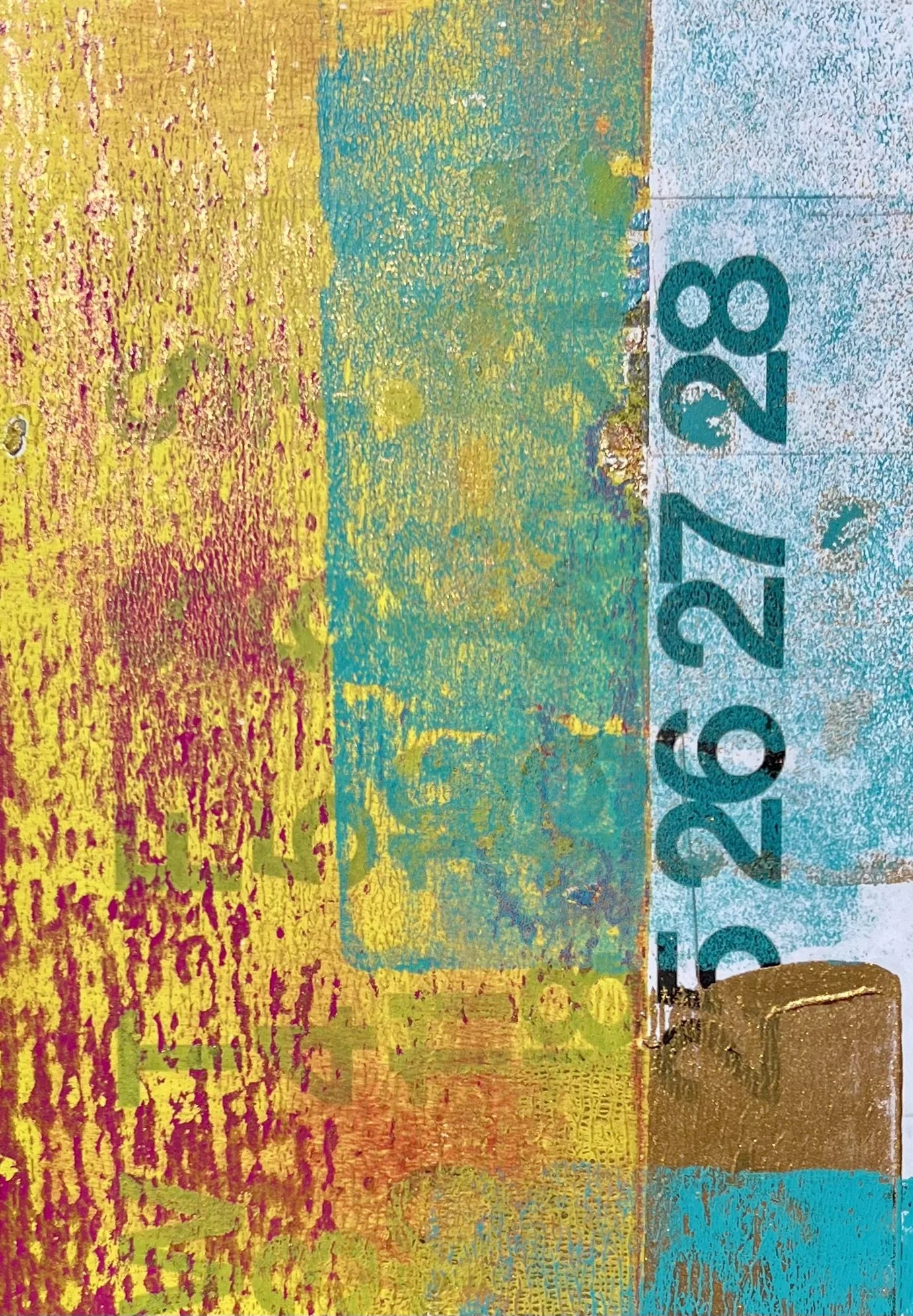
Original art, created for a collectible notebook; sold. Photo by Glenyse Thompson
What original art actually costs — and what surprises people
Originals from my studio start at $1,300, framed. I also create collectible notebooks that start at $40. That is the entry point for a one-of-a-kind, signed, documented piece of contemporary abstract art by an artist with a decade of exhibition history, editorial coverage in Architectural Digest, Southern Living, Town and Country, and Elle Decoration UK, and work in collections from Boston to Honolulu.
Most people, when they hear that number for the first time, are surprised that it is not higher. Some are surprised it is that much. Both reactions make sense.
Here is the honest truth about price: it reflects the material cost of making the work, the time it takes, the context of the artist's career and recognition, and the market for that artist's work over time. My prices are where they are because I have done the work — a decade of exhibitions, press, collaborations, and sustained practice — and because the work itself has earned its place in the market.
The useful comparison is not with prints or mass-produced art objects. It is with other things you spend significant money on and live with every day — furniture, rugs, renovation choices. A piece of original art at $1,300 or $3,000 or $5,000, hung in a room you spend real time in, has more daily impact on your quality of life than most of those other investments. And unlike a sofa, it is likely to appreciate.
How to start without overwhelming yourself
Start with what you love, not what you think you should buy. I cannot say this strongly enough. The collectors I know who have built extraordinary collections did not start with strategy. They started with a piece that stopped them. Everything else followed from that.
Start at a scale you can live with. If you are not sure how you feel about living with original art, start with a smaller piece — something on paper, something in the mid-range price point. Get used to having original work in your space. Let yourself discover that you want more of it.
Come to open studio before you decide anything. Every second Saturday at the ArtsXchange in St. Petersburg, my studio is open to anyone who wants to walk through. No appointment, no ticket, no pressure. Over 210 people come every month. Many of them come the first time just to look — and find that being in the room with the work answers questions that a website never could.
Consider a giclée print as a starting point. My giclée prints on canvas are high-quality reproductions of select works, available at a more accessible price point than originals. I don’t have many in-stock, as they are all one-of-one, created to exhibit or collect. This a great way to start with a smaller piece. They are a real way to begin living with my work before you are ready to commit to an original. And they mean you are already in relationship with the work when the time comes to step up.
Ask questions. Email me. Reply to a newsletter. Come to open studio and find me in person. The conversation costs nothing, and I would genuinely rather help you find the right piece than have you buy the wrong one.
The mistake people regret most
I have had more than one person come back to open studio and tell me that they almost bought a specific piece two months ago, hesitated, and now it is gone. They are always a little sad about it. Sometimes more than a little.
Original work exists once. The specific piece you are looking at right now — on my website, on my Artsy page, on the wall of my studio — will not exist in the same way once it is sold. Someone will take it home. It will become part of their life. And you will be looking at a sold tag.
I am not saying this to manufacture urgency. I am saying it because it is true, and because the hesitation people feel about buying original art is almost never about the money or the space or the readiness. It is about the fear of making a mistake.
The only mistake I see people make is waiting too long for a piece they already know they love.
Come find yours
My studio is open every second Saturday. Over 210 people come through every month. The work on the walls includes pieces that will never be listed online — pieces that exist only in that room until they find the collector they belong with.
Browse available art, giclée's at glenyse.com/original-art. Open studio takes place every second Saturday of the month at the ArtsXchange, 515 22nd Street South, Studio 109, St. Petersburg, FL. To get on the advance new-work list, subscribe at glenyse.com. or contact hello@glenyse.com to discuss a commission made specifically for your space. For direct inquiries, 312-725-6066.
Glenyse Thompson is a Florida-based contemporary abstract artist whose work has been featured in Designer Today, Aspire Home and Design, Architectural Digest, Southern Living, Town and Country, Design Milk, and Martha Stewart and placed in private collections and commercial spaces nationally and worldwide. She enjoys commissioning art for collectors, exhibiting art, working with brands and interior designers, and collaborating with companies on licensing opportunities.